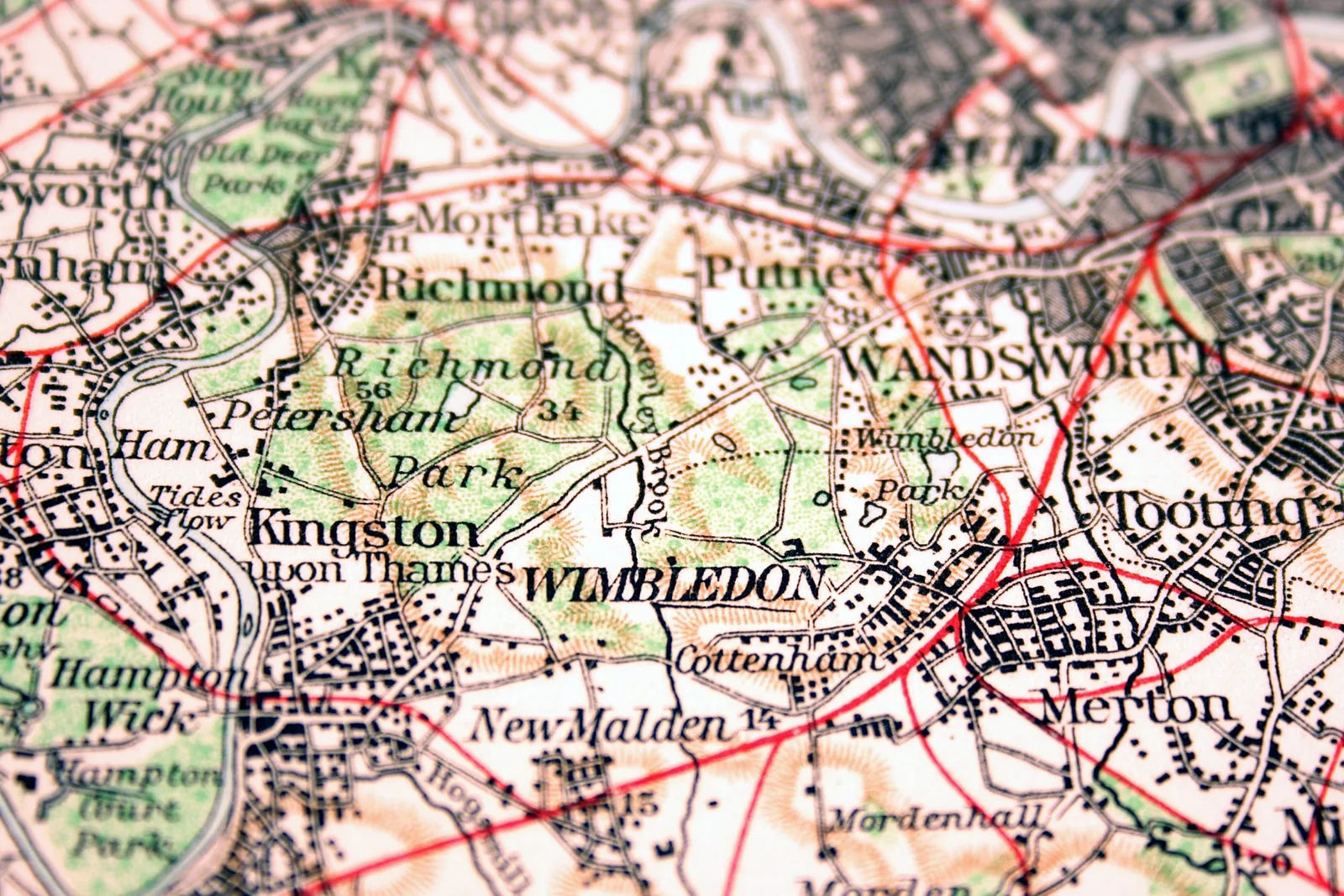
My office sits in a building called The Apprentice Shop, and the name is literal. This is where apprentices once learned textile printing, on the banks of a river that spent several centuries as one of the hardest-working stretches of water in England. Most people who visit the weekend market at Merton Abbey Mills have no idea what happened here. It deserves telling.
The priory
Start in the twelfth century. Merton Priory was founded beside the Wandle in the 1110s and grew into one of the most important religious houses in the country. Thomas Becket was educated here. So was Walter de Merton, who went on to found Merton College, Oxford. In 1236 the Statute of Merton (often called the first English statute) was agreed within its walls.
Henry VIII dissolved it in 1538 and the buildings were pulled down, some of the stone reportedly carted off for his palace at Nonsuch. What survives is remarkable in its way: the Chapter House foundations are preserved beneath Merantun Way, a few minutes' walk from my desk. A twelfth-century powerhouse, under a dual carriageway. London does this sort of thing constantly and hardly anyone notices.
The river goes to work
The Wandle drops steadily on its short run from Croydon and Carshalton to the Thames, and falling water was industrial power. By the eighteenth and nineteenth centuries this modest river drove one of the densest concentrations of mills in the country: flour, copper, snuff, leather, and above all textiles. The water's quality suited bleaching and dyeing, and the meadows along its banks were laid out with calico drying in the sun.
The snuff mills survive at Morden Hall Park, now in the care of the National Trust, a short walk upstream. The whole route is stitched together today by the Wandle Trail, which passes directly through Merton Abbey Mills and is one of the best flat walks or rides in South London.
Morris and Liberty
Two names lift this stretch of riverbank into design history. In 1881 William Morris moved his workshops to Merton Abbey, just across the river from where the Mills stand now, and for decades Morris & Co produced its printed textiles, tapestries and stained glass here, dyeing with natural indigo in the Wandle's water.
The Mills site itself became a print works whose blocks and tables supplied Liberty of London, printing the silks that made the Regent Street store famous. The waterwheel that powered the works still turns beside the market today, and the Colour House (where dyes were mixed) survives as a small theatre. When you buy vegetables at the weekend market, you are standing on the floor of one of the great production sites of the Arts and Crafts movement.
What it means now
Industry left, as it did everywhere, and the river has been quietly restored: it is now a genuinely healthy chalk-fed stream with trout in it, herons on it, and kingfishers if you are patient. The Mills settled into their present life of market stalls, studios, food and the occasional pottery wheel.
I find the continuity of it appealing. This corner of SW19 has been a place where people made things, carefully, by hand, for the better part of nine centuries: manuscripts, then calico, then Morris prints, then Liberty silk. An independent business working from The Apprentice Shop feels less like an accident of lettings availability and more like joining a very long queue.
If you live nearby and have never walked the Wandle Trail from Colliers Wood through the Mills to Morden Hall Park, give it an hour on a Sunday. It is the best free history lesson in the postcode.
What to do next
If this article has raised questions about your own property, the next step is a calm conversation. I can look at the property, the market evidence and the practical choices in front of you, then give you a clear view of what I would do next.
Would a measured valuation help?
For calm, evidence-led advice about selling or letting in Wimbledon, speak directly with Brenchley’s.